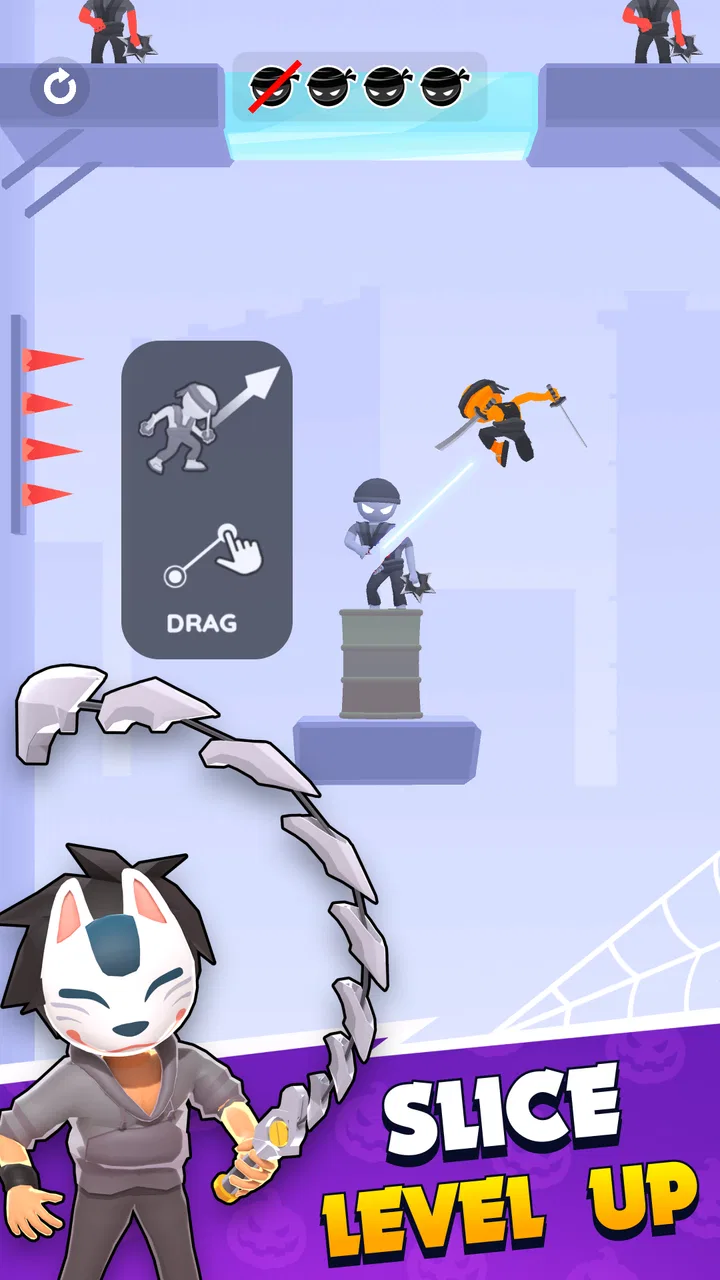
Slicing Hero Sword Master Game
- 4.5
- Rating
- 10.00M
- Installs
- Free
- Price

 Analysis by App-foxy
I spent time with Slicing Hero Sword Master Game as a quick-action mobile game, and my first impression was clear: it wants to turn the simple act of cutting into the whole challenge. You play as a ninja-like fighter, use a katana, and move through encounters built around timing, positioning, and fast reactions. It is free to download, aimed at players aged 10 and up, and developed by Enderun Studios.
The appeal is easy to understand. This is the kind of game I can open for a short session without needing to remember a complicated story or manage a large inventory. The action begins with the basic fantasy of reaching enemies through teleportation and slicing them down, but the enjoyment depends on learning when to act rather than simply tapping as quickly as possible. That gives it a more focused identity than a standard button-mashing action game.
How the current version feels to play
The current release is version 1.1.2, and it presents itself as a compact action experience rather than a large role-playing adventure. I would not approach it expecting deep character building, a long narrative campaign, or the broad exploration found in a console-style action title. Its strength is the short loop: see the situation, decide where the attack should land, commit to the movement, and deal with the result.
You May Also Like

 Blood Strike: 2.5 Anniversary
Blood Strike’s Loadouts Turn Every Drop Into a Tactical Gamble
A close look at Blood Strike’s custom loadouts: how fast access to signature weapons reshapes its battle royale rhythm, rewards preparation, and narrows the gap between fights.

 Pandora - Music & Podcasts
Pandora’s Music Is Easy to Start, but Harder to Recover
Pandora’s strength is its low-effort path from a seed to a station. Its weak spot is how much confidence it asks you to place in connection, setup, and quiet recovery.

 8 Ball Pool
 Is Built on Rivalries, Rematches, and Routine
A close look at the rivalries, rematches, shared routines, and unanswered safety questions that turn a quick pool match into a persistent mobile community.

 Samsung Music
’s Quiet Strength Is Playing What You Already Own
Its reach comes less from spectacle than from dependable access to a personal library. That simplicity is both the app’s strongest retention engine and its ceiling.

 AccuWeather: Weather Radar
AccuWeather Review: A Quick, Clear Forecast for Everyday Decisions
For everyday plans, the best forecast is the one you can understand quickly. AccuWeather makes rain timing, radar, and local conditions easy to act on, with a few trade-offs.

 Hill Climb Racing
Why Hill Climb Racing Still Turns Crashes Into One More Run
A tiny car, a bumpy hill and one more upgrade: Hill Climb Racing keeps resurfacing because its simple chaos makes every near-miss feel personal.
More From Our News Desk



That compact design works particularly well on a phone. Touch controls are most enjoyable when the screen is not overloaded with buttons, and a sword-slicing game benefits from keeping attention on the action itself. I found the best sessions were the ones where I treated each encounter as a small timing puzzle instead of rushing through it. The ninja theme gives those decisions a satisfying purpose: teleporting is not just movement, but part of the attack rhythm.
The game belongs firmly in the action category, though its appeal is more about precision than sustained combat complexity. Players who enjoy quick reactions and repeating a challenge to improve their performance will understand its rhythm quickly. Players who prefer a large map, extensive dialogue, or a detailed equipment system may find the experience too narrow.
A simple idea with a useful learning curve
The central mechanic is approachable, but that does not mean every attempt feels identical. At first, the katana fantasy may encourage reckless swiping. After a while, I started paying more attention to the order of threats and the space around the target. That change in mindset is important. The game is more satisfying when I slow down mentally, even if the action on screen remains fast.
One practical tip is to avoid treating every opening as an invitation to attack immediately. I had better results when I watched the arrangement of enemies first and chose a route that reduced the chance of being caught in a bad position. This is one of the less obvious strengths of the design: the game can reward restraint, not only speed.
Another useful habit is to use short sessions for practice rather than judging the game after a single failed run. The first attempt can feel simple because the controls are easy to understand. The challenge becomes clearer when I repeat a situation and notice that my failure came from poor timing or an overconfident movement. That makes the restart loop more meaningful than a purely random action game.
What the developer’s update history suggests
Enderun Studios has brought the game to its current 1.1.2 release, which is the version I would use when assessing it today. The game first appeared on September 4, 2022, so it is not a brand-new experiment. That matters because the current build should be judged as an established mobile release rather than as an early concept that still needs to prove its basic idea.
The version information is useful, but I would separate what is visible now from what a player might hope to see later. The present release supports the core slicing-and-teleporting identity. It does not automatically promise a larger campaign, new modes, or a deeper progression system. I would be cautious about choosing the game because of imagined future additions; the current action loop needs to be enough on its own.
For someone returning after an older installation, the sensible approach is to update before drawing conclusions. A current build gives a fairer impression of the controls and general balance than an outdated copy. It also avoids judging the developer’s present work by memories of an earlier state. That is especially relevant for a game whose enjoyment depends on small details in responsiveness and encounter pacing.
Why the current state suits short mobile sessions
I see the strongest use case during small gaps in the day. If I have a few minutes before leaving home, while waiting for an appointment, or during a short break, I can play without preparing for a long commitment. The game’s action-first format makes it easier to start than a story-heavy title that expects me to remember objectives and characters.
It also works for players who like practicing one skill repeatedly. The useful question is not only whether I completed a stage or encounter, but whether I can make the same decision more cleanly next time. That gives the game a modest training quality. I can focus on reaction timing, attack direction, and avoiding unnecessary movement instead of trying to master several unrelated systems at once.
There is a trade-off, though. Short-session design can become repetitive if the player does not enjoy refining a familiar action pattern. Someone looking for constant surprises may prefer a roguelike with more varied builds, while someone wanting a traditional sword game may prefer a title with blocking, combos, and a larger combat vocabulary. This game’s focused loop is a benefit only if that focus matches your taste.
What existing players gain and where the friction remains
The game has reached a substantial audience, with more than ten million installs and an average rating of 4.5 from roughly thirty-seven thousand ratings. Those figures suggest that the basic concept has connected with many mobile players, but they do not replace personal testing. A popular quick-action game can still be a poor fit for someone who dislikes repetition, touch-based precision, or optional spending.
For existing users, the current version is best understood as a continuation of the original promise rather than a complete change of genre. If you already enjoy the katana-and-teleportation loop, the appeal is likely to come from becoming more consistent. If you stopped playing because you wanted a much broader adventure, a version update alone may not address that preference. The game’s identity remains concentrated around slicing action.
One of the more useful ways to play is to separate experimentation from progress. During an early attempt, I might test how aggressively I can move or whether a particular target can be reached from an unexpected angle. On a later attempt, I can use the safer route. This makes failure informative instead of merely frustrating. It also helps prevent the common mobile-game habit of repeating the same mistake without changing the plan.
Free access and the spending decision
The game is free, with optional in-app purchases priced from $2.99 to $7.99 per item. That makes it easy to try before deciding whether the action is worth supporting financially. I appreciate that arrangement for a game with a very specific taste profile: the central question is whether you enjoy the movement and slicing rhythm, and a free starting point lets you answer that directly.
My advice is to play enough to understand the normal challenge before considering a purchase. If the attraction comes from improving your timing, spending may not be necessary to enjoy the core idea. If a purchase changes how quickly you progress, the important trade-off is convenience versus satisfaction. Some players want to move forward with less friction, while others prefer earning progress through repeated attempts.
Parents should also remember that free does not mean completely separate from spending. The age classification is Everyone 10+, and the presence of optional purchases makes it worth checking device-level purchase controls for younger players. That is a practical point rather than a criticism of the combat design. A child may focus on the sword action while an adult needs to manage the account settings around optional items.
Where it is stronger than familiar alternatives
Compared with a conventional fighting game, this title appears more immediately readable. I do not need to memorize a long list of attack commands before understanding what the katana is meant to do. Compared with an endless runner, it offers more deliberate decision-making because the key moment is choosing how to reach and cut a target, not simply avoiding obstacles while moving forward.
It also has a different appeal from a large action role-playing game. Those games can offer richer customization and longer-term goals, but they often demand more time and attention. Here, the compact format is the advantage. I can concentrate on one satisfying action instead of managing quests, equipment, dialogue, and a wide map.
The comparison works the other way too. If you want layered combat, a substantial story, or meaningful build choices, a larger action game is likely to be the better purchase of your time. If you want the endless variety of a procedural game, this focused sword loop may feel limited. The best reason to choose it is not its size, but its clarity.
Small techniques that improve the experience
My first concrete recommendation is to play with attention on the next safe decision, not on the entire screen at once. Looking at every enemy equally can make the action feel chaotic. Identifying the immediate target and the likely follow-up gives the teleport mechanic a more deliberate role.
Second, use unsuccessful attempts as a way to identify the exact moment your plan broke. Did you attack before the route was clear? Did you move too far? Did you assume that speed would solve a positioning problem? Asking that question turns the game from a reflex test into a compact exercise in visual judgment.
Third, do not confuse a quick win with a good route. A fast approach can work once and still be unreliable. When I repeated a challenge, I valued a path that left room to react over one that looked spectacular but depended on perfect timing. That is a worthwhile trade-off for players who want steady improvement rather than a lucky success.
Who should skip it
I would skip this game if my main goal were a deep ninja simulation. The theme is present through the katana, teleportation, and assassin-style action, but the experience is built around a streamlined mobile loop. It is not the right choice for someone who wants extensive stealth systems, open-ended exploration, or a detailed story about a warrior’s journey.
I would also look elsewhere if I disliked repeating short challenges. The game’s satisfaction comes from learning and refining, so repetition is part of the appeal rather than an accidental side effect. Players who need constant new mechanics may prefer a campaign with more frequent changes in structure.
Finally, players who want a completely purchase-free environment should pay attention to the optional items. The game remains free to start, but the spending layer exists. That does not make it unsuitable for everyone; it simply means families and careful budgeters should decide in advance whether purchases will be allowed.
What I would watch in future updates
When I look at a game like this, I watch for changes that deepen the central action without burying it. New ways to approach a target, more meaningful reasons to replay encounters, or better variety in the situations would all support the existing identity. The important distinction is that added content should make slicing decisions more interesting, not merely add more screens around them.
I would also pay attention to how the game serves two different audiences: newcomers who need immediate controls and experienced players who want more demanding choices. A good evolution would preserve the accessible opening while giving practiced players reasons to refine their routes. That balance is difficult, but it is more valuable here than simply increasing the number of systems.
For now, I would judge the release on what it already offers. The version number and release history show a game that has moved beyond its original launch, but they are not a reason to assume a particular future direction. My recommendation is based on the present: try the free experience, assess whether the timing-based sword loop holds your attention, and only then decide whether optional purchases or continued play make sense.
My recommendation
I recommend Slicing Hero Sword Master Game to players who want a focused action title that can fit naturally into short mobile sessions. The katana theme is easy to grasp, the teleporting approach gives the slicing mechanic a distinct flavor, and the best moments come from replacing frantic swipes with deliberate choices. Enderun Studios has a clear central idea here, and the current 1.1.2 release is easy to evaluate on its own terms.
I would not recommend it as a substitute for a full fighting game, a story-driven ninja adventure, or a deep role-playing game. Its limits are closely tied to its strengths: the narrow loop is approachable and convenient, but it may not satisfy players who need extensive variety. For me, that makes it a good casual action pick rather than an all-purpose mobile game.
In the end, the deciding test is simple. If you enjoy seeing a route, committing to a strike, and improving after a failed attempt, the free download is worth trying. If you want the game to provide its excitement through constant unlocks or a large world, you will probably outgrow it quickly. I like it most when I treat each session as a small exercise in timing, and that focused purpose is what makes this sword game worth recommending to the right player.
FAQs for Slicing Hero Sword Master Game
01What is Slicing Hero Sword Master Game about?
Slicing Hero Sword Master Game is an action-focused mobile game centered on sword combat, quick reactions, and cutting through enemies or objects across progressively challenging stages. Players control a sword-wielding hero, perform attacks by following on-screen gestures or taps, and try to complete levels while avoiding mistakes. The game is designed for short sessions, making it suitable for casual play, although later challenges may require more accurate timing and repeated practice.
02How do you play Slicing Hero Sword Master Game?
Gameplay is generally easy to understand: guide the hero’s sword using touch controls to slice targets, defeat opponents, and clear obstacles. Success depends on choosing the correct moment and direction rather than simply attacking as quickly as possible. As levels advance, enemies, barriers, and timing requirements become more demanding. New players should begin carefully, learn the attack patterns, and use deliberate swipes instead of making rushed movements.
03Is Slicing Hero Sword Master Game free to download and play?
The game is typically available as a free download, allowing players to try its main gameplay without paying upfront. However, free mobile games may include advertising, optional purchases, or other monetization features, depending on the version and platform. Before downloading, check the official store listing for current information about in-app purchases, advertisements, supported devices, and any restrictions. Availability and pricing can also vary by country.
04Does Slicing Hero Sword Master Game require an internet connection?
Whether an internet connection is required can depend on the version installed and the features you want to use. Basic levels may work offline in some releases, while advertisements, updates, cloud synchronization, events, or reward systems may require online access. If you plan to play while traveling or without mobile data, test the game after installation with Wi-Fi and mobile data disabled, and review the developer’s latest store description.
05Is Slicing Hero Sword Master Game suitable for children and all mobile devices?
The game may be appropriate for players who enjoy simple action and cartoon-style sword challenges, but parents should review its official age rating, advertising, and in-app purchase settings before allowing children to play. Device compatibility can vary because performance depends on the phone or tablet’s operating system, memory, and graphics capability. Installing the latest supported version and keeping sufficient storage available can help prevent crashes or slow gameplay.
Pros
- Simple swipe controls make sword slicing easy to learn.
- Fast-paced levels are ideal for short gaming sessions.
- Satisfying cutting animations make successful slices feel rewarding.
- Progression encourages players to improve timing and accuracy.
- The colorful presentation is accessible for casual players.
Cons
- Gameplay may feel repetitive after extended play.
- Some stages rely heavily on similar slicing patterns.
- Precision can be difficult on smaller phone screens.
- Frequent ads may interrupt the flow for free players.
- Limited depth may disappoint fans of complex action games.

Slicing Hero Sword Master Game
Gallery